
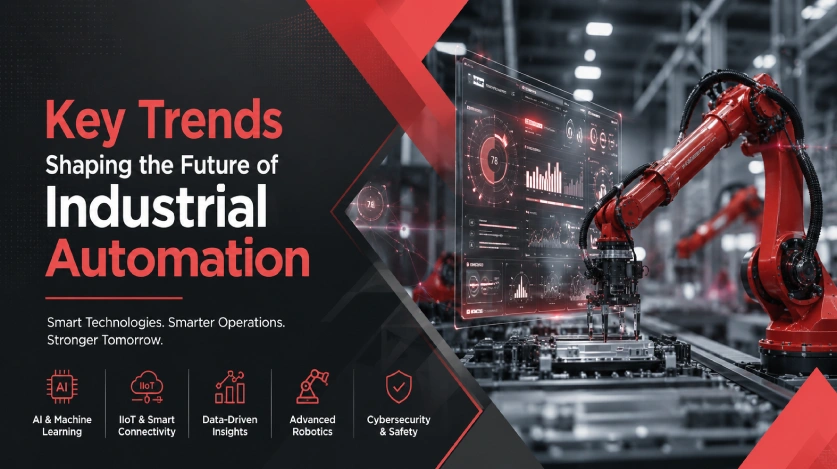
Key Trends Shaping the Future of Industrial Automation
How AI, robotics, IIoT, and data intelligence are redefining the factory floor — and the enterprise behind it.
AI-Powered Systems
How AI is transforming automation from rule-based to cognitive systems
IIoT Backbone
Why the Industrial Internet of Things is the backbone of smart factories
Collaborative Robots
How cobots are redefining human-machine teamwork on the floor
Digital Twins
The role of digital twins in simulation-driven operational excellence
Edge Computing
Why edge computing is critical for real-time automated decision-making
Cybersecurity
How to secure increasingly connected industrial environments
The Automation Revolution Is Already Here
Industrial automation is no longer a distant prospect reserved for futuristic factories. It is reshaping supply chains, manufacturing floors, and enterprise operations right now — at a scale and speed that was unimaginable a decade ago. Driven by breakthroughs in artificial intelligence, robotics, the Industrial Internet of Things (IIoT), and advanced data analytics, the global automation landscape is undergoing a profound transformation.
Industrial automation in 2026 is defined not just by the machines that replace human effort, but by the intelligent systems that amplify human decision-making and reshape entire business models.
Automation is no longer about replacing labour — it's about multiplying intelligence across every layer of the enterprise.
— Industry PerspectiveAI-Powered Automation: From Rule-Based to Cognitive
STEP 01 — AI & Machine Learning IntegrationArtificial intelligence has elevated automation from deterministic, rule-based programming to dynamic, self-learning systems capable of adapting to real-world variability.
Modern AI-driven industrial automation systems leverage machine learning, computer vision, and natural language processing to perform complex tasks that were previously impossible to automate. From quality inspection and defect detection to autonomous process control, AI is enabling machines to make contextual decisions — not just execute predefined instructions.
Key developments in this space include:
- Predictive maintenance: AI algorithms analyse sensor data to predict equipment failures before they occur, reducing downtime by up to 50%.
- Vision-guided robotics: Machine vision systems allow robots to identify, pick, and sort components with sub-millimetre accuracy.
- Autonomous quality control: Deep learning models inspect products at high speeds, catching defects that human inspectors routinely miss.
The IIoT Ecosystem: Connected Intelligence at Scale
STEP 02 — Industrial Internet of Things (IIoT)The IIoT connects machines, sensors, controllers, and enterprise systems into a unified data fabric — enabling real-time visibility and intelligent control across operations.
The Industrial Internet of Things is the backbone of the modern smart factory. By deploying thousands of sensors and connected devices across production environments, organisations can monitor and manage every variable — from temperature and vibration to throughput and energy consumption — in real time.
IIoT's most impactful applications in 2026:
- Remote asset monitoring: Continuous oversight of equipment health across distributed facilities without on-site personnel.
- Digital twin integration: Virtual replicas of physical systems that mirror live operational data for simulation and analysis.
- Energy optimisation: Automated load balancing and consumption analytics that reduce industrial energy costs significantly.
- Supply chain synchronisation: Real-time data exchange between suppliers, production lines, and logistics partners.
The global IIoT market is projected to exceed $1.1 trillion by 2028, making it one of the fastest-growing technology segments in industrial history. (Source: IoT Analytics)
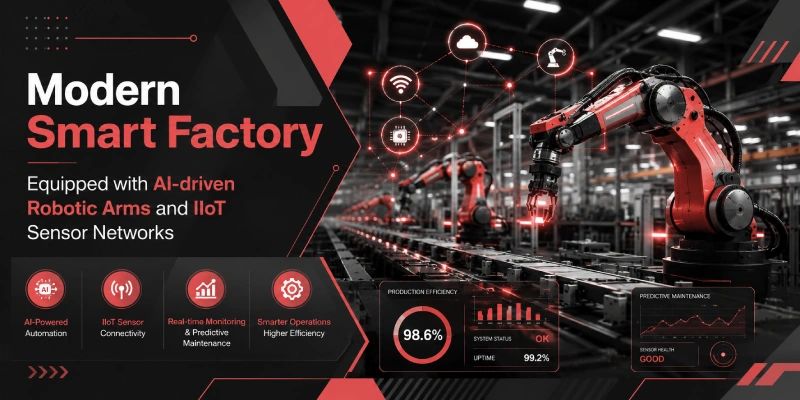
Modern smart factory floor equipped with AI-driven robotic arms and IIoT sensor networks
Collaborative Robotics (Cobots): The Human-Machine Partnership
STEP 03 — Collaborative Robots (Cobots)Unlike traditional industrial robots confined to caged environments, cobots work safely alongside humans — augmenting capability without replacing entire workflows.
One of the most significant industrial automation trends reshaping the factory floor is the rise of collaborative robots. Cobots are designed with built-in force and proximity sensors that allow them to pause or halt when a human enters their workspace — making human-robot collaboration both practical and safe.
Why cobots are gaining rapid adoption:
- They require minimal programming expertise, allowing rapid deployment by non-specialists.
- They can be redeployed to different tasks, offering operational flexibility.
- They are significantly more affordable than traditional industrial robots.
- They complement human workers in ergonomically challenging or high-precision tasks.
Digital Twins and Simulation-Driven Optimisation
STEP 04 — Digital Twin TechnologyDigital twins create virtual counterparts of physical assets, processes, or entire facilities — enabling engineers to test, optimise, and predict outcomes before deploying changes in the real world.
Digital twin technology represents a fundamental shift in how industrial organisations plan, manage, and improve operations. By creating a live, data-synchronised virtual model of a physical system, engineers and operators can run simulations, stress tests, and scenario analyses without ever touching the actual equipment.
Proven business outcomes of digital twin deployment:
| Outcome | How It Works | |
|---|---|---|
| Faster product development | Simulate manufacturing processes before building physical prototypes, saving time and material costs. | |
| Operational risk reduction | Identify bottlenecks and failure points in virtual environments before they cause real-world disruptions. | |
| Remote diagnostics | Engineers can diagnose and resolve issues from anywhere by interacting with a real-time virtual model. | |
| Lifecycle management | Track asset performance across its entire lifecycle, enabling smarter decisions on maintenance and replacement. |
Edge Computing: Processing Power at the Source
STEP 05 — Edge Computing in AutomationBy processing data at or near the source — on the factory floor itself — edge computing eliminates latency, reduces bandwidth costs, and enables real-time automated responses.
As industrial environments become more data-intensive, relying solely on centralised cloud infrastructure introduces unacceptable latency for time-critical automation tasks. Edge computing addresses this by deploying processing capabilities directly at the operational edge — on machines, sensors, and local gateways.
How edge computing is reshaping industrial automation:
- Millisecond response times for safety-critical systems that cannot tolerate cloud round-trip delays.
- Continuous operation even when cloud connectivity is interrupted.
- Reduced data transmission costs by filtering and pre-processing sensor data locally.
- Enhanced data privacy by keeping sensitive operational data on-premises.
Gartner predicts that by 2026, over 75% of enterprise-generated data will be created and processed outside traditional data centres — a trend that directly drives edge automation adoption.
Cybersecurity in Automation: The Growing Imperative
STEP 06 — Industrial CybersecurityAs automation systems become increasingly connected, securing operational technology (OT) networks from cyber threats is now as critical as protecting IT infrastructure.
The convergence of IT and OT networks has dramatically expanded the cyber-attack surface of industrial organisations. High-profile ransomware attacks on critical infrastructure have demonstrated that cybersecurity is not a peripheral concern for industrial automation — it is a core pillar of operational resilience.
Essential cybersecurity practices for automated environments:
| Practice | Description | |
|---|---|---|
| Network segmentation | Isolating OT networks from corporate IT systems to contain potential breaches. | |
| Zero-trust architecture | Verifying every user and device, regardless of network location, before granting access. | |
| Continuous monitoring | Deploying intrusion detection systems specifically designed for industrial protocols. | |
| Security by design | Embedding security requirements into automation system design from the outset, not as an afterthought. |
Trends at a Glance
| Trend | Core Benefit | Impact Level | |
|---|---|---|---|
| AI-Powered Automation | Cognitive decision-making & predictive capabilities | ★★★★★ | |
| IIoT Ecosystem | Real-time visibility & connected intelligence | ★★★★★ | |
| Collaborative Robotics | Safe human-machine teamwork & flexibility | ★★★★☆ | |
| Digital Twins | Simulation-driven optimisation & risk reduction | ★★★★☆ | |
| Edge Computing | Ultra-low latency & on-premise processing | ★★★★☆ | |
| Industrial Cybersecurity | OT/IT convergence protection & resilience | ★★★★★ |
Preparing Your Organisation for the Automation-First Era
Understanding the trends is only the beginning. Translating them into tangible competitive advantage requires a structured, three-phase approach:
Assess
Audit your current automation maturity, identify high-impact use cases, and map gaps in your data infrastructure.
Pilot
Launch focused proof-of-concept projects for AI, IIoT, or robotics in contained environments to validate ROI before scaling.
Scale
Build a governance framework, upskill your workforce, and integrate proven automation solutions enterprise-wide.
Ready to Automate Smarter?
Explore our automation services to discover how our team can guide your transformation journey — from strategy and architecture to implementation and managed support.
Take the Next Step