
IT Modernization Frameworks for
Scalable Digital Enterprise Transformation
Every day a business runs on outdated technology, it loses ground — in speed, in efficiency, and in opportunity. The good news? Modernization does not have to be overwhelming. With the right framework, any organization can upgrade its technology infrastructure in a structured, low-risk, and cost-effective way.
Most modernization efforts fall short not because of bad intent, but because there is no clear plan. This guide lays out exactly what IT modernization means, which frameworks work best, and how to build a step-by-step roadmap that delivers real results — without disrupting your day-to-day operations.
THE CORE PROBLEM — Why Do IT Modernization Initiatives Fail?
According to McKinsey, over 70% of large-scale technology transformations fall short of their objectives. The primary culprits are consistent across industries:
- No phased roadmap — teams attempt full rewrites instead of incremental upgrades
- Legacy system dependencies are underestimated, creating integration bottlenecks
- Misalignment between IT strategy and broader business goals
- Talent gaps in cloud architecture, DevOps, and microservices
- Underinvestment in change management and organizational readiness
A structured IT modernization framework directly addresses each of these failure points.
What Is IT Modernization? A Strategic Definition
IT modernization refers to the systematic process of updating, replacing, or re-architecting legacy systems, applications, and infrastructure to align with current and future business demands. It is a foundational component of any successful digital enterprise transformation strategy.
Modernization is not simply about adopting new tools — it encompasses a cultural shift, a governance overhaul, and a reimagining of how technology serves business strategy. It spans cloud migration, application re-platforming, API-led integration, DevOps adoption, and data modernization.
Core Components of IT Modernization
| COMPONENT | DESCRIPTION |
|---|---|
| Cloud Migration | Transition workloads from on-premises to hybrid, public, or private cloud environments |
| Application Modernization | Re-platform, refactor, or replace legacy applications with cloud-native architectures |
| Data Modernization | Build scalable data platforms, data lakes, and real-time analytics capabilities |
| DevSecOps Adoption | Integrate development, security, and operations for faster, secure delivery cycles |
| API-Led Connectivity | Decouple systems using APIs to enable modular, scalable integration architecture |
| Infrastructure Modernization | Shift to software-defined infrastructure, containers, and Kubernetes orchestration |
Leading IT Modernization Frameworks Explained
Several battle-tested frameworks guide enterprises through structured, risk-managed digital transformation. Below are the most widely adopted models:
1. The Gartner PACE Layered Framework
Gartner's PACE framework categorizes enterprise systems into three layers — Systems of Record, Systems of Differentiation, and Systems of Innovation — each with different modernization velocities. This allows organizations to prioritize which systems need rapid transformation versus which require stable, incremental updates.
- Systems of Record: Core backend systems (ERP, CRM) modernized for stability and compliance
- Systems of Differentiation: Applications delivering competitive advantages — updated every 1–3 years
- Systems of Innovation: Emerging tech experiments requiring rapid, agile iteration cycles
2. The 6R Cloud Migration Framework (AWS/Gartner)
The 6R Framework provides a structured decision model for migrating workloads to the cloud. Each 'R' represents a modernization strategy matched to application complexity and business value:
| Strategy | Approach | Best For |
|---|---|---|
| Rehost | Lift-and-shift to cloud with minimal change | Quick migrations, cost savings |
| Replatform | Migrate with minor optimizations | Moderate modernization needs |
| Refactor | Re-architect for cloud-native capabilities | High-value, complex apps |
| Repurchase | Replace with SaaS solution | Commodity applications |
| Retire | Decommission obsolete systems | End-of-life applications |
| Retain | Keep on-premises for now | Compliance or dependency bound |
3. The TOGAF Enterprise Architecture Framework
TOGAF (The Open Group Architecture Framework) is one of the most comprehensive frameworks for enterprise IT strategy and modernization governance. Its ADM (Architecture Development Method) provides a cyclic, iterative approach to defining and managing the transformation of enterprise architecture.
TOGAF excels in large organizations where IT governance, compliance, and cross-functional alignment are paramount to modernization success.
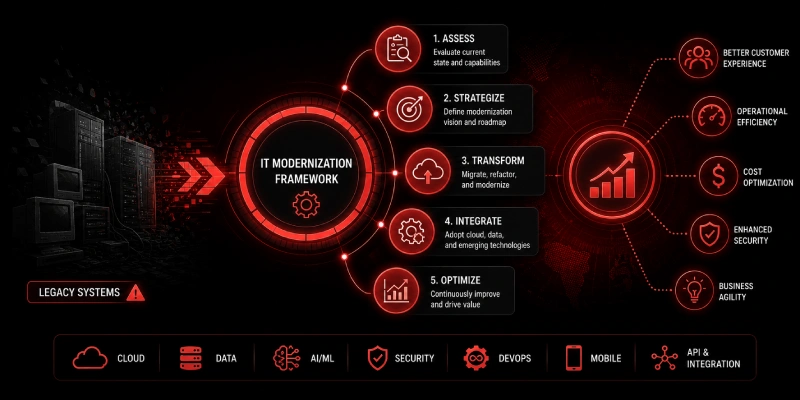
A Practical 5-Phase IT Modernization Roadmap
Regardless of which framework you adopt, a phased implementation approach is essential to minimize risk, manage costs, and deliver measurable value at each stage.
Assessment & Discovery
Audit existing IT landscape. Map legacy dependencies, technical debt, and capability gaps. Establish KPIs aligned to business outcomes.
Tools: CMDB, application portfolio assessment toolsStrategy & Architecture Design
Define the target-state architecture. Select modernization framework(s). Prioritize workloads using business value vs. complexity scoring matrices.
Pilot & Proof of Concept
Execute low-risk modernization pilots. Validate cloud patterns, DevOps pipelines, and API integrations. Gather stakeholder feedback before scaling.
Scaled Execution & Migration
Roll out modernization waves across the portfolio. Apply CI/CD pipelines, containerization (Docker/Kubernetes), and microservices decomposition systematically.
Optimization & Continuous Innovation
Implement AIOps and observability platforms. Establish feedback loops for continuous improvement. Automate governance, cost optimization, and security compliance.
The 4 Non-Negotiable Pillars of Scalable IT Modernization
Cloud-First Architecture
Adopt hybrid or multi-cloud strategies to ensure scalability, resilience, and cost efficiency. Cloud-native design patterns — serverless, containers, microservices — are foundational to modern enterprise agility.
Security & Compliance by Design
Embed Zero Trust security principles, identity governance, and regulatory compliance (GDPR, SOC 2, HIPAA) into every layer of the modernization architecture from day one.
Data-Driven Decision Making
Modernize data infrastructure to enable real-time analytics, AI/ML capabilities, and unified data governance. A modern data platform is the engine of intelligent enterprise operations.
Agile Delivery & DevSecOps
Transform delivery models with DevSecOps pipelines, automated testing, and infrastructure-as-code practices. Agility at scale requires both tooling maturity and cultural alignment.
Common Pitfalls to Avoid in Digital Enterprise Transformation
Big Bang vs. Incremental Modernization
Attempting a full-stack overhaul in a single release cycle is the most common — and costly — mistake. Incremental, value-driven waves reduce risk while delivering tangible improvements faster.
Neglecting the Human Element
Technology transformation fails when organizational change management is an afterthought. Upskilling programs, executive sponsorship, and cross-functional collaboration are non-negotiable success factors.
Vendor Lock-In Risk
Over-dependence on a single cloud or platform vendor creates strategic vulnerability. Design for portability using open standards, containerization, and cloud-agnostic architectures.
Measuring Modernization Success: Key Metrics
A successful IT modernization program must be anchored in measurable outcomes. Track the following KPIs to validate progress and guide investment decisions:
Industry Snapshot: Where Modernization Is Happening Fastest
Certain sectors are leading the charge in enterprise IT modernization. Understanding where and why offers instructive benchmarks:
| Industry | Modernization Focus | Key Driver |
|---|---|---|
| Financial Services | Core banking modernization, API-banking | Real-time payments, open banking |
| Healthcare | Cloud EHR, interoperability platforms | Patient outcomes, compliance (HIPAA) |
| Retail & E-Commerce | Microservices, real-time inventory | Omnichannel CX, personalization |
| Manufacturing | IoT integration, edge computing | Industry 4.0, predictive maintenance |
| Government | Legacy mainframe migration | Citizen services digitization |
Frequently Asked Questions (FAQ)
IT modernization focuses on updating technology systems and infrastructure, whereas digital transformation is the broader business strategy of using technology to change how an organization creates and delivers value to customers. Modernization is an enabler of transformation.
Timelines vary by scope and organizational complexity. A focused application modernization initiative may take 6–18 months, while enterprise-wide digital transformation programs typically span 3–5 years. Phased execution ensures value delivery throughout the journey.
TOGAF is generally preferred for large enterprises due to its comprehensive governance structure. The 6R Framework is ideal for cloud migration planning, while the PACE model suits organizations prioritizing innovation velocity alongside system stability.
The greatest risk is undiscovered dependencies in legacy codebases that create cascading failures during migration. A thorough dependency mapping and application portfolio assessment before migration planning mitigates this risk significantly.
Absolutely. While enterprise frameworks like TOGAF are designed for large organizations, the core principles — phased migration, cloud adoption, API integration, and DevOps — apply at any scale. SMBs benefit especially from SaaS adoption and cloud-first strategies.
ROI is measured through a combination of cost metrics (infrastructure savings, reduced maintenance costs), operational metrics (system availability, deployment frequency), and business metrics (time-to-market improvement, customer satisfaction scores).
KEY TAKEAWAYS
- IT modernization is a strategic business imperative, not just a technology upgrade
- Proven frameworks (PACE, 6R, TOGAF) provide structured, risk-managed transformation paths
- A phased 5-step roadmap ensures measurable value delivery at every stage
- Cloud-first architecture, security by design, data modernization, and DevSecOps are the four essential pillars
- Measurement through DORA metrics, SLAs, and TCO analysis validates modernization ROI
Conclusion: Build Your Modernization Engine Today
IT modernization is the single most critical lever available to enterprises seeking scalable, resilient, and competitive digital transformation. The organizations that invest in structured frameworks, phased roadmaps, and continuous innovation today will define the digital enterprise standards of tomorrow.
The journey from legacy infrastructure to a cloud-native, AI-ready enterprise is complex — but with the right frameworks, the right partners, and a disciplined execution approach, it is entirely achievable.
Ready to Start Your Modernization Journey?
Partner with experts who have guided enterprises through large-scale digital transformation. From assessment to execution, we bring the frameworks, talent, and technology to accelerate your modernization roadmap.
Contact Us Today