
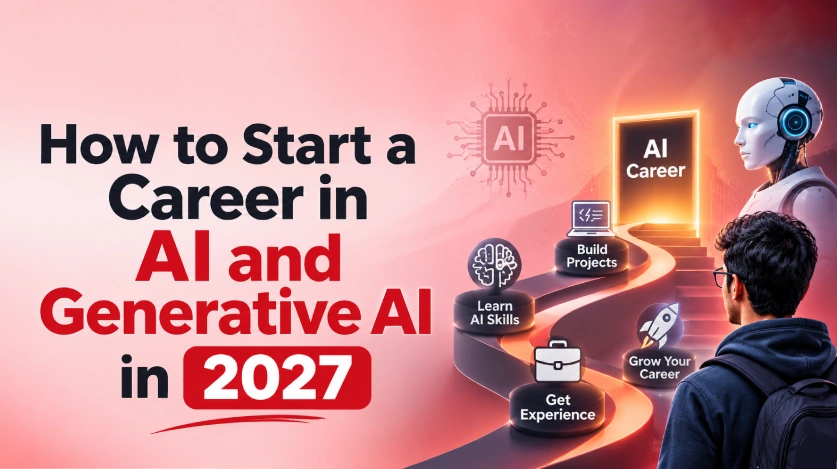
How to Start a Career in AI and Generative AI in 2027
Artificial intelligence (AI) is becoming part of everyday business software, from customer support and data analysis to software development and workflow automation. Generative AI has expanded these possibilities by helping applications create text, code, images, summaries, and other content.
For beginners and experienced professionals alike, the challenge is knowing which skills to learn, which career path to choose, and how to turn learning into practical experience.
Quick Summary
To start a career in AI and generative AI, learn Python, SQL, Git, and data fundamentals first. Then study machine learning, build generative AI applications, and practice testing and deploying your work. Build projects that demonstrate your skills, document your decisions, and use current job descriptions to understand what employers expect for your target role.
You do not need to master every AI tool or build a model from scratch to begin. A strong foundation in programming, data, problem-solving, and software engineering can support progress across many AI-related careers.
Why Do AI and Generative AI Skills Matter in 2027?
Organizations are using AI to analyze information, automate repetitive work, improve customer experiences, and support business decisions. The focus is moving beyond experimentation: organizations also need people who can integrate AI into existing systems and evaluate the results.
The World Economic Forum’s Future of Jobs Report 2025 identifies AI and machine learning specialists among the job roles employers expect to grow through 2030. These are employer expectations, not a guarantee of new openings for every candidate or in every region.
The 2026 AI Index Report from Stanford HAI reports that 88% of surveyed organizations used AI in at least one business function in 2025. This shows that organizational adoption is widespread, but adoption figures do not directly measure the number of jobs created.
Generative AI has also expanded the range of applications. Large language models (LLMs) can support document search, conversational assistants, content workflows, and software tools. Building useful applications takes more than writing prompts. Developers must consider information quality, privacy, security, evaluation, response time, and cost.
AI career opportunities vary by location, industry, experience, and role. Before choosing a learning path, review several current job descriptions in your target region and note the skills they repeatedly request.
 A strong foundation in programming, data, and problem-solving supports progress
across AI-related careers.
Which AI and Generative AI Career Paths Should You Know?
AI includes several career paths. The best option depends on your current skills, interests, and the kind of work you want to do.
| Career Role | Main Responsibilities | Useful Starting Skills |
|---|---|---|
| AI/ML Engineer | Develops, evaluates, and deploys machine learning models | Python, statistics, machine learning, model evaluation |
| Generative AI Developer | Builds applications using LLMs, APIs, retrieval, and related tools | Python, APIs, prompt design, RAG, evaluation |
| Data Engineer | Builds pipelines that collect, transform, and organize data | SQL, Python, databases, data processing |
| MLOps Engineer | Supports deployment, monitoring, and maintenance of ML systems | Python, Git, Docker, CI/CD, monitoring |
| Data Analyst | Analyzes data and communicates insights to support decisions | SQL, spreadsheets, Python, statistics, BI tools |
How should you choose an AI career path?
Consider the kind of work you enjoy:
These roles overlap, and job titles vary between organizations. Data analytics can provide a foundation for further study in machine learning, but moving into an AI engineering role typically requires additional technical skills and project experience.
You do not need to choose a permanent specialization immediately. Start with shared fundamentals, then use projects and job descriptions to narrow your direction.
What Computer Science Skills Do You Need for an AI Career?
Before moving into advanced AI topics, build the fundamentals that help you write, understand, debug, and maintain software.
How Much Mathematics and Machine Learning Do You Need?
The mathematics you need depends on your career path. Many applied AI roles require a working understanding of core concepts, while research-focused roles generally require deeper mathematics.
Start with these areas:
Next, learn core machine learning concepts: supervised and unsupervised learning, training and test data, overfitting, and model selection.
Begin with scikit-learn and manageable datasets before moving to deep learning frameworks such as PyTorch or TensorFlow. Choose one framework first rather than trying to master both.
Learn the difference between a baseline model and an improved model, and select evaluation metrics that fit the task. For classification, precision, recall, and F1-score can reveal problems that accuracy alone may hide, especially when classes are imbalanced.
Which Generative AI Skills Should You Learn?
Once you have programming, data, and machine learning fundamentals, learn how generative AI applications work.
A Basic RAG Application Flow
Prepare Documents
Collect permitted documents and extract their text.
Split Content
Divide text into useful sections while preserving context.
Create Embeddings
Convert text into numerical representations for similarity search.
Retrieve
Find passages related to the user’s question.
Generate
Provide retrieved passages and the question to the LLM.
Evaluate
Check relevance and whether the answer is supported by sources.
Handle Uncertainty
Let the application say when information is insufficient.
RAG can help an application use organization-specific or frequently updated information, but it does not guarantee accuracy. Poor retrieval, incomplete documents, ambiguous questions, and unsupported generation can still cause errors.
Should you learn RAG or fine-tuning first? They solve different problems. RAG is suitable for applications that need to retrieve information from external documents or a changing knowledge base. Fine-tuning can adapt a model to particular task patterns, response formats, or specialized behavior, depending on the model and available training data.
Start by defining the problem. RAG is often a practical starting point for document question-answering systems. Fine-tuning may be worth considering when prompt design and retrieval do not meet the task’s requirements. The two approaches can also complement each other. When cost, speed, or data privacy matter, small language models (SLMs) are another option worth learning.
Which Cloud, Testing, and Security Skills Matter?
A working prototype is not necessarily a reliable application. AI systems used in real products must be tested, deployed, monitored, and maintained. Build familiarity with these areas:
You do not need advanced expertise in all these areas before your first project. Learn each practice as you move from a prototype to a deployed application.
Which Projects Should You Build for an AI Portfolio?
Projects show how you apply technical concepts to real problems. A strong portfolio demonstrates your decisions, testing, evaluation, and understanding of limitations, not just the final output. Build projects that become progressively more challenging.
| Project | Goal | How to Extend It | What It Demonstrates |
|---|---|---|---|
| Data Cleaning & Analysis | Use a public dataset to answer a practical question | Add visualizations and a written summary of findings | Data preparation, analytical reasoning, readable code |
| Sentiment Classification | Classify text such as product reviews into sentiment categories | Compare models and analyze misclassified examples | Training, precision, recall, F1-score, error analysis |
| Document Q&A with RAG | Answer questions from public or authorized documents | Add source citations, an evaluation set, and tests for missing information | Embeddings, retrieval, source-grounded answers, evaluation |
| NL-to-SQL Assistant | Convert a user’s question into a query on a sample database | Add query validation, read-only access, and clear error handling | SQL, structured outputs, input validation, security |
How should you document your projects?
For each project, include:
- The problem: What the project does and who might find it useful.
- The approach: The tools, libraries, data, and design choices you used.
- The evaluation: How you tested quality and what the results showed.
- The limitations: Where the system fails and what you would improve.
- How to run it: Setup instructions, dependencies, and sample inputs.
- A demonstration: A working demo, screenshots, or a deployment link where appropriate.
To explain your design choices clearly, see our guide on how to document your architecture decisions. Publish your code in an organized GitHub repository, and never include credentials, private documents, or other sensitive information. Three distinct, well-documented projects can give you useful material to discuss in interviews, especially when they demonstrate different skills. One deployed project is a valuable addition if it is tested and maintained.
Why Do Problem-Solving and Communication Skills Matter?
Technical skills are only part of AI development. Professionals must understand the problem, explain trade-offs, work with other teams, and communicate uncertainty.
Practice breaking a broad business request into measurable requirements. Instead of defining a goal as “build an AI chatbot,” specify the information it should answer from, which questions it must handle, how answer quality will be evaluated, and what it should do when it cannot find relevant information.
Learn to explain why you chose a particular model or approach, what the evaluation results show, where the application fails, what security or privacy risks exist, and how cost, latency, and quality affect design decisions.
Documentation, teamwork, critical thinking, and the ability to explain technical choices are useful across AI engineering, data science, and software development. Stay current by following a small number of reliable resources and revisiting your learning goals regularly; you do not need to adopt every new framework as soon as it appears.
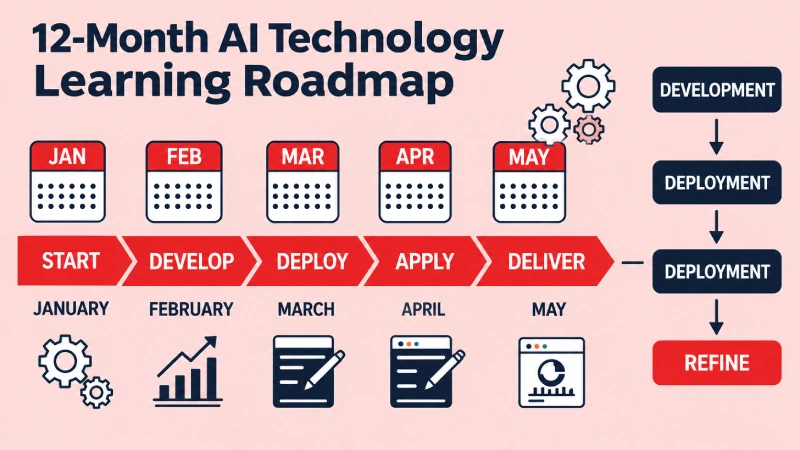 A structured 12-month roadmap turns an hour a day into a portfolio of deployable
projects.
A Practical 12-Month Learning Roadmap
The roadmap below assumes about an hour of study a day and ends every phase with a working project, so progress is visible to employers as well as to the learner. Anyone with prior programming experience can shorten the Foundation phase to one or two months.
Months 1–3: Foundation
Focus: Python, data structures, SQL, Git and GitHub, and the Linux command line.
Project: a data-cleaning script for a public dataset, published on GitHub with a README.
Outcome: writes, tests, and shares clean code.
Months 4–6: Core ML
Focus: linear algebra, probability, statistics, scikit-learn, model evaluation (precision, recall, F1), and cloud basics.
Project: a sentiment classifier trained on public review data.
Outcome: trains, evaluates, and explains a model.
Months 7–9: Generative AI
Focus: deep learning with PyTorch, LLM APIs, prompt design, embeddings, and RAG.
Project: a document Q&A chatbot built with RAG.
Outcome: builds and evaluates an LLM application.
Months 10–12: Production
Focus: Docker, deployment, testing with pytest, security (API keys, prompt injection), and mock technical interviews.
Project: the RAG chatbot deployed behind a FastAPI endpoint, with tests and documentation.
Outcome: presents a portfolio of three projects and is interview-ready.
Review progress at the end of each phase. If the project does not work yet, spend extra weeks on that phase before moving on, because each later phase builds on the one before.
Remember: an hour a day builds more skill than an occasional weekend marathon.
How Can Career Switchers and Non-Computer Science Graduates Start?
A computer science degree is not required for every AI-related position, but the technical requirements still apply. Your education and professional experience can help you choose a relevant project and understand a real problem.
Finance, Healthcare, Operations
Use your domain knowledge to build a project around a problem you understand, such as a document question-answering application for authorized policy documents or an analysis of a public dataset. Learn Python, SQL, data preparation, and the AI concepts your use case requires.
Marketing, Teaching, Content
Start with Python and data fundamentals while learning how generative AI applications work. Text analysis, document search, content classification, and evaluation are possible project areas. Prompt design alone is not enough for most AI engineering roles, so build programming skills if that is your goal.
Software Testing or Tech Support
Your experience in debugging, test design, and quality assurance can transfer to testing and evaluating AI applications. Add Python, APIs, data handling, and machine learning concepts.
Already a Software Developer
You may already know APIs, version control, testing, and deployment. Focus on the gaps in statistics, machine learning, LLM integration, retrieval, and evaluation.
Choose a role based on the requirements of actual job openings. Build on your strengths while addressing the technical gaps that your target role requires.
What Makes an AI Portfolio Useful to Employers?
A portfolio helps reviewers understand how you approach a problem, make technical decisions, and assess the result. Focus on these elements:
- Working code: The project can be set up and tested using the provided instructions.
- Clear documentation: The README explains the problem, architecture, dependencies, and design choices.
- Evaluation: You provide evidence of how performance or answer quality was measured.
- Error analysis: You discuss failures and limitations instead of showing only successful examples.
- Responsible handling: Credentials are protected, data is used appropriately, and security risks are considered.
- A clear demonstration: A reviewer can understand the project without having to guess how it works.
Avoid creating several nearly identical chatbot projects with no evaluation or documentation. A focused portfolio that demonstrates different technical abilities is more informative than a collection of unfinished projects.
What Common Mistakes Should You Avoid?
- Skipping the fundamentals: Learning tools without understanding programming, data, or model evaluation creates gaps that can limit your progress.
- Collecting courses without building: Turn what you learn into small, practical projects.
- Relying entirely on AI-generated code: Read, test, and understand code before including it in a project.
- Learning too many tools at once: Start with a manageable set and add tools when a project requires them.
- Ignoring testing and evaluation: A chatbot that works on one example may fail on others, so test representative scenarios and document the results.
- Publishing sensitive information: Never upload private datasets, passwords, API keys, or confidential documents to public repositories.
- Treating a timeline as a job guarantee: Compare your abilities with the responsibilities of the roles you want.
- Chasing every new AI trend: Learn transferable principles and adopt new tools when they solve a real problem.
Frequently Asked Questions
Start with Python, SQL, Git, and data fundamentals, then learn machine learning basics and model evaluation. Move on to LLM APIs, prompt design, embeddings, and retrieval-augmented generation (RAG). Build practical projects, document your work on GitHub, and learn to test and deploy your applications. Focus on demonstrated skills rather than collecting tools or certificates.
No, a computer science degree is not mandatory for every AI role. Some employers require or prefer a relevant degree, particularly for specialized positions. Programming ability, technical knowledge, relevant experience, and well-documented projects can help demonstrate your skills. Check the requirements of the positions you want because hiring criteria vary by employer.
Python is a practical first choice because it is widely used in data analysis, machine learning, and generative AI applications. Learn SQL alongside it to retrieve and analyze structured data, and use Git to manage your code. Once you know these fundamentals, apply them to real datasets and small AI projects.
There is no fixed timeline. A 12-month plan can provide structure, but progress depends on previous experience, available study time, project depth, and the target role. Experienced developers may progress faster in areas that build on their existing skills. Assess readiness by demonstrating relevant skills and comparing them with actual job requirements.
It is possible to enter the field without previous professional AI experience, but entry-level opportunities can be competitive. Build projects that demonstrate programming, problem-solving, testing, and evaluation. Keep your code organized, document your decisions, and deploy an application where appropriate. Data analysis or software development roles can also provide a foundation for further specialization in AI.
Yes. Start with Python, SQL, and data fundamentals, then build machine learning or generative AI skills for your chosen path. Your industry knowledge can help you find useful problems to solve, such as a document question-answering application for authorized policy documents or an analysis of a public dataset from your field.
AI can be a promising career for people who enjoy technology, problem-solving, and continuous learning. The World Economic Forum’s Future of Jobs Report 2025 identifies AI and machine learning specialists among the roles employers expect to grow through 2030. Opportunities vary by location, industry, experience, and specialization, so build practical skills instead of relying on broad predictions about the job market.
AI is changing how many tasks are performed, although the impact varies across occupations. The International Labour Organization’s 2025 update on generative AI and jobs estimates that one in four workers worldwide is in an occupation with some degree of exposure to generative AI. Exposure does not automatically mean job loss; the report indicates that most jobs are more likely to be transformed than made redundant. Learning to use, evaluate, and work responsibly with AI can help professionals adapt as their roles change.
Conclusion
Starting a career in AI and generative AI in 2027 means building technical foundations, applying them to practical problems, and learning to evaluate the results.
Begin with Python, SQL, Git, and data fundamentals. Develop your machine learning knowledge, explore generative AI applications, and practice the engineering skills needed to test, deploy, and maintain them. Choose a career path that matches your interests and the roles you want, build projects that show your decisions and evaluation methods, and let your skills and portfolio—not a calendar—tell you when you are ready to apply.
For organizations exploring practical AI adoption, SoftTune Technologies provides AI and Machine Learning services focused on areas such as predictive analytics, natural language processing, recommendation systems, and AI-powered automation. Whether you are building an AI application or exploring how AI can support business operations, start by understanding the problem, choosing appropriate tools, and building solutions that can be tested and evaluated.
Explore SoftTune AI Services