
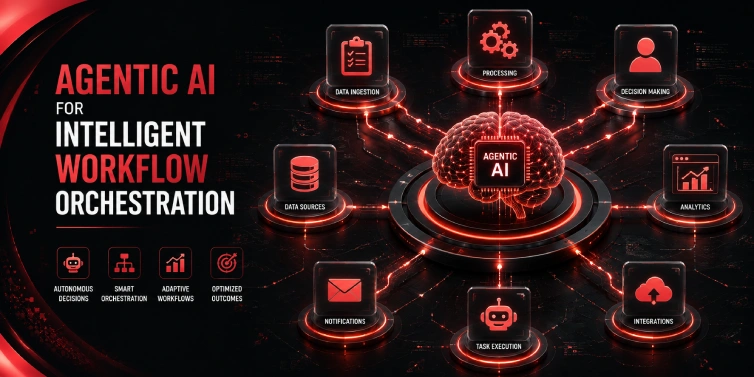
Agentic AI for Intelligent Workflow Orchestration
How autonomous AI agents are redefining process coordination, decision-making, and enterprise-scale automation
Traditional automation follows fixed rules. Modern enterprises, however, operate in environments that change by the hour. Static workflows struggle when exceptions appear, data arrives late, or priorities shift mid-process. This is where agentic AI enters the picture—and transforms intelligent workflow orchestration from a rigid sequence of steps into an adaptive, goal-driven system.
In this guide we break down what agentic AI really means for workflow orchestration, the concrete problems it solves, a practical implementation framework, and the practices that separate successful deployments from stalled pilots.
1. What Is Agentic AI?
Agentic AI is a type of artificial intelligence that can take action on its own to reach a goal. Instead of just answering a question or generating text, these AI systems (called agents) can break a big task into smaller steps, use tools or systems, check their progress, and adjust when something goes wrong—all with little ongoing human help.
Agentic AI combines autonomous decision-making with intelligent automation to help organizations solve increasingly complex business problems. For enterprises exploring practical adoption, AI and machine learning services provide the foundation for designing, integrating, and scaling these systems.
Here are the main things that make agentic AI different:
Agentic AI is more than just "smarter automation." Instead of following a fixed process map, the agents look at the current situation and decide the best next step to reach the business goal.
2. The Problem with Traditional Workflow Orchestration
Most enterprise orchestration platforms excel at deterministic, high-volume, predictable processes. They falter when reality intervenes:
-
Exception handling becomes a manual escalation loop that slows everything down.
-
Cross-system coordination relies on brittle integrations that break when data formats or APIs change.
-
Knowledge work (approvals, triage, root-cause analysis) still requires constant human judgment.
-
Process improvement cycles are measured in months because every change needs redesign and retesting.
The result is a growing gap between what the business needs—adaptive, resilient, end-to-end processes—and what traditional orchestration can deliver without heavy human intervention.
3. How Agentic AI Powers Intelligent Workflow Orchestration
Intelligent workflow orchestration powered by agentic AI treats the process as a living system. An orchestration layer (or supervisor agent) receives a goal, decomposes it, selects the right specialist agents or tools, monitors execution, and re-plans when conditions change.
Task Analysis & Decomposition
The system breaks a high-level objective into granular, executable steps.
Dynamic Agent Selection
The right agent (or human) is chosen based on capability, context, and current load.
State & Memory Management
Shared context travels with the workflow, with well-structured data engineering pipelines helping ensure agents do not lose critical information.
Adaptive Routing & Re-planning
When an exception occurs, the orchestrator evaluates alternatives instead of failing hard.
Observability & Guardrails
Full audit trails, policy checks, and human-in-the-loop checkpoints keep autonomy safe.
| Dimension | Traditional Orchestration | Agentic Orchestration |
|---|---|---|
| Control logic | Fixed rules & BPMN paths | Goal-driven planning + rules |
| Exception handling | Manual escalation queues | Autonomous re-planning |
| Adaptability | Requires redesign cycles | Learns & adjusts at runtime |
| Human involvement | High for exceptions & decisions | Targeted, high-value checkpoints |
| Best suited for | High-volume, stable processes | Complex, variable, knowledge-heavy work |
4. A Practical Framework for Getting Started
Successful adoption of agentic AI for intelligent workflow orchestration follows a deliberate path rather than a big-bang rewrite.
Identify High-Value, High-Variability Processes
Look for workflows that currently require frequent human judgment, span multiple systems, or suffer from long exception queues. Customer onboarding, claims handling, IT incident resolution, and supply-chain exception management are common starting points.
Map Current State and Define Clear Goals
Document the existing process, pain points, data sources, and decision points. Define measurable outcomes (cycle time, exception rate, cost per case, first-contact resolution). Agentic systems perform best when the target outcome is explicit.
Design the Agent Mesh and Orchestration Pattern
Choose the right collaboration model:
Supervisor–worker for hierarchical control and clear accountability.
Sequential pipeline when steps have strong dependencies.
Peer-to-peer or swarm for parallel exploration or creative problem-solving.
Decide which steps remain deterministic (rules, RPA bots) and which benefit from agent reasoning.
Implement Guardrails, Observability, and Human Checkpoints
Autonomy without control is risk. Embed policy agents, approval gates for high-impact actions, comprehensive logging, and the ability to pause or roll back. Treat observability as a first-class requirement from day one.
Pilot, Measure, Iterate, Scale
Start narrow. Run controlled pilots, compare against baseline metrics, collect feedback from process owners, refine agent prompts and tools, then expand the scope. Organizations that redesign the workflow around agent capabilities—not just bolt agents onto old processes—capture far more value.
Blend deterministic orchestration (BPMN, rules engines, RPA) with agentic layers. Keep the reliable backbone for stable steps and introduce agents where variability and judgment create the biggest bottlenecks.
5. Business Benefits That Matter
Faster cycle times
Agents work around the clock and parallelize work that previously waited in queues.
Higher resilience
Dynamic re-planning reduces the impact of late data, system outages, or unexpected inputs.
Better use of human expertise
People focus on exceptions that truly need judgment and on continuous improvement.
Scalable knowledge work
Complex case management and multi-step research become more consistent and capacity-flexible.
Continuous improvement loop
Agents can surface patterns and suggested optimizations that humans can approve and institutionalize.
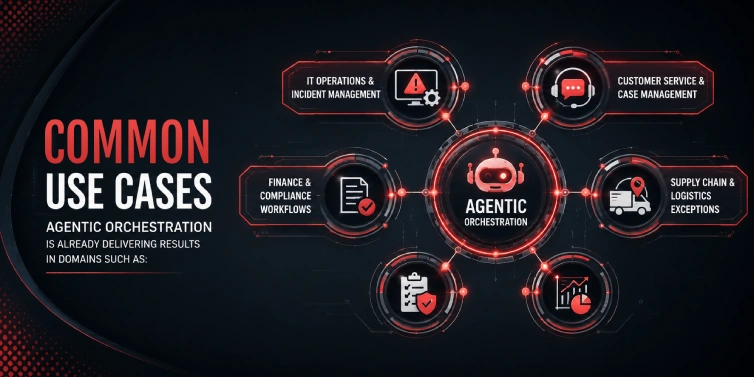
6. Common Use Cases
Agentic orchestration is already delivering results in domains such as:
IT operations & incident management
Agents triage alerts, correlate events, propose remediations through DevOps automation pipelines, and escalate only when necessary.
Customer service & case management
Multi-agent systems gather context from customer service management platforms, draft responses, trigger backend actions, and hand off complex cases.
Finance & compliance workflows
Agents assemble evidence packages, perform checks against policies, and route for human sign-off.
Supply chain & logistics exceptions
Dynamic re-planning when shipments, inventory, or demand signals deviate from the plan.
7. Challenges and How to Address Them
Agentic systems introduce new considerations:
Complexity & cost of infrastructure
Start with focused use cases and leverage existing cloud infrastructure and agent platforms where possible.
Observability and debugging
Invest early in tracing, structured logging, and replay capabilities.
Governance and risk
Define clear autonomy boundaries, approval matrices, and audit requirements before scaling.
Agent sprawl
Maintain a registry of agents, ownership, and purpose to avoid uncontrolled proliferation.
Frequently Asked Questions
Looking Ahead
Agentic AI is moving intelligent workflow orchestration from rigid automation into adaptive, goal-oriented systems that can handle the complexity of real enterprise operations. Organizations that treat agents as collaborators within a well-governed orchestration fabric—not as isolated experiments—will unlock faster processes, greater resilience, and more meaningful use of human talent.
The shift is already underway. The practical question is no longer whether agentic orchestration will matter, but how quickly teams can build the skills, guardrails, and workflow designs to put it to work.
Ready to explore agentic AI for your workflows?
Discover how intelligent workflow orchestration can transform your processes. Talk to our AI solutions team to start the conversation.
Talk to Our Team