
- SOFTTUNE
- January 2026
- Technology
Share this :
Why Python Isn’t Slowing Down: The Future of AI, Automation, and Data Science
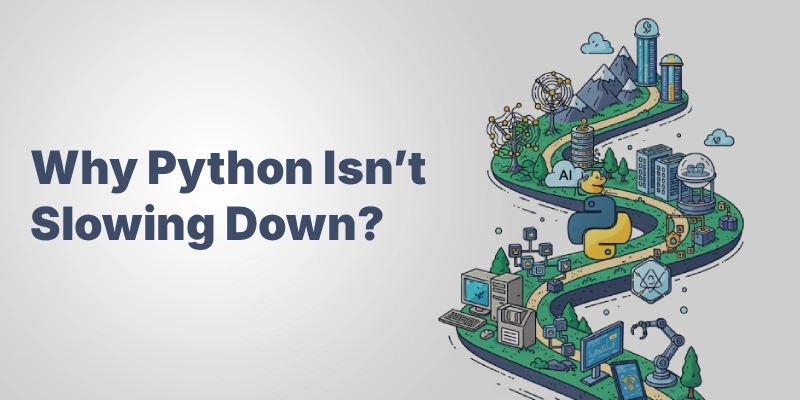
Python has been around for decades, yet its momentum continues to grow stronger every year. While many programming languages rise and fall with trends, Python has managed to remain relevant, adaptable, and deeply embedded in modern technology. From artificial intelligence and automation to data science and cloud computing, Python is not just surviving—it’s shaping the future.
This article explores why Python isn’t slowing down, how it continues to dominate emerging technologies, and what its future looks like in AI, automation, and data science.
The Timeless Simplicity That Powers Innovation
One of Python’s greatest strengths is its simplicity. Unlike many programming languages that require complex syntax and steep learning curves, Python feels natural—even for beginners. This simplicity is not a limitation; it’s a strategic advantage.
Developer Focus
Developers can focus on solving problems instead of fighting syntax, which makes Python ideal for innovation-driven fields like AI and automation.
Team Collaboration
Python’s readability also makes collaboration easier across teams, including data analysts, engineers, and product managers.
Python’s Expanding Role in Artificial Intelligence
Artificial Intelligence is evolving rapidly, and Python is at the center of this transformation. Most modern AI frameworks and research tools rely heavily on Python, making it the preferred language for machine learning engineers and researchers.
Python fits AI development perfectly due to its flexibility and ecosystem. It allows for seamless integration with various tools and platforms, making it the go-to choice for complex algorithms.
- Extensive AI libraries (TensorFlow, PyTorch)
- Strong community support
- Rapid innovation cycles
AI models require constant experimentation, testing, and iteration. Python allows developers to prototype quickly, refine models efficiently, and integrate AI into real-world applications without friction.
As generative AI, large language models, and autonomous systems continue to grow, Python’s role becomes even more critical.
Automation: Python as the Silent Productivity Engine
Automation is no longer an option; it's a need for modern enterprises. Python has become one of the most trusted tools for automating repetitive tasks, workflows, and system processes.
IT & DevOps
Process automation in IT and DevOps environments.
Business Tasks
Business automation like report generation and data handling.
Integration
Compatibility with APIs, cloud platforms, and third-party tools.
Data Science and Analytics: Python’s Stronghold
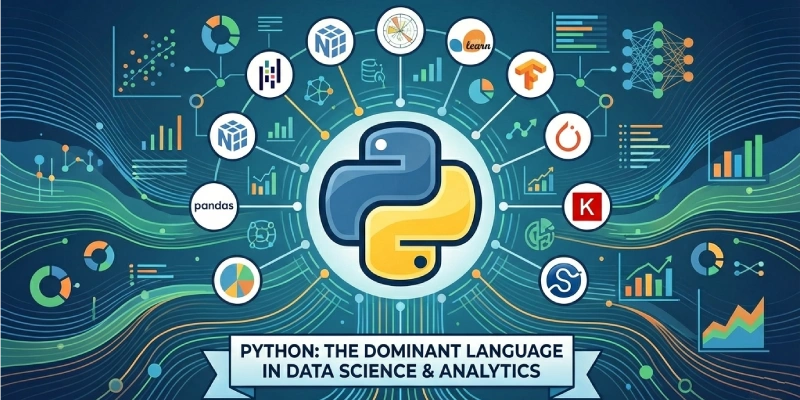
Data is the foundation of modern decision-making, and Python remains the dominant language in data science and analytics. Its libraries and tools are designed specifically for handling, analyzing, and visualizing large volumes of data.
Why Data Scientists Choose Python
- Powerful Ecosystem: Python offers an unmatched combination of simplicity and power. Popular tools include Pandas and NumPy for data manipulation.
- Visualization: Use Matplotlib and Seaborn for creating compelling visualizations.
- Integration Ready: Python integrates easily with databases, big data platforms, and cloud-based analytics services. This makes it a complete solution—from raw data ingestion to advanced predictive modeling.
Cloud-Native & Generative AI
The future of software development is cloud-native, and Generative AI has changed how applications interact with users. Python fits naturally into both environments.
Python Application Domains
| Domain | Key Python Applications |
|---|---|
| Cloud Development |
|
| Generative AI / LLMs |
|
Python’s Community: The Real Growth Engine
A language is only as strong as its community, and Python’s global ecosystem is one of the most active in the world. Developers continuously contribute libraries, frameworks, tutorials, and open-source projects.
Why Python Will Continue to Dominate the Future
Python isn’t slowing down because it evolves with technology rather than chasing it. It remains relevant by solving real-world problems efficiently and at scale.
- AI and data demand is increasing globally
- Businesses prioritize speed, flexibility, and integration
Final Thoughts: Python Is a Strategic Skill, Not Just a Language
Python’s continued growth is not accidental. It’s the result of thoughtful design, a powerful ecosystem, and unmatched adaptability. Whether it’s artificial intelligence, automation, data science, or cloud computing, Python remains the backbone of innovation.
For developers, learning Python is an investment in long-term relevance. For businesses, adopting Python means faster innovation and smarter automation.